Calgary Interfaith Council's UN World Interfaith Harmony Week's Opening Ceremony

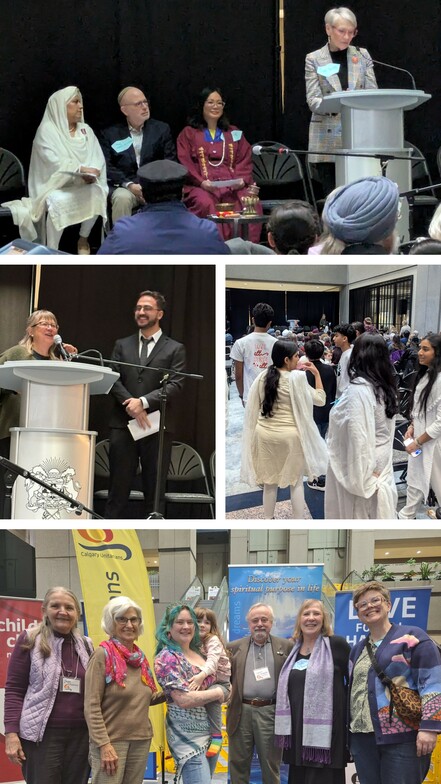
In a time of deep division—political, religious, cultural—I want to introduce Unitarian Universalism as a spiritual tradition shaped by a longing for confluence: a place where different streams of faith and conviction can meet without losing their distinct currents.
We are a living tradition. We are not bound by a single creed or scripture but held together by a shared commitment to seek truth, meaning, and compassion—together. We believe we belong to one another, even when we do not think alike, worship alike, or speak about the sacred in the same way. Our life together is not uniformity, but relationship—many voices flowing into a shared life.
Unitarian Universalism has its roots in people who chose conscience over conformity. Early Unitarians questioned inherited doctrines and trusted reason and moral intuition. Early Universalists proclaimed that love—not fear—is the deepest truth of the universe, and that no one is outside the reach of the sacred.
These were not separate paths for long. They became a confluence—streams of thought and faith joining together, shaping one another, creating something wider and more life-giving than either could be alone.
These ideas were dangerous in their time. People were punished, exiled, even killed for insisting that faith must be freely chosen. Yet those risks were taken because our spiritual ancestors believed something essential: belonging cannot be coerced. It can only be invited. True faith emerges where freedom and relationship meet.
One of the clearest expressions of this belief comes from Transylvania in 1568, during a time of violent religious conflict across Europe. Leaders gathered at what was called the Diet of Torda, under enormous pressure to enforce religious unity.
Instead, they chose another way. They declared that preachers may teach according to their understanding, congregations may choose what resonates with them, and no one shall be compelled. Faith, they said, is a gift—not a command.
In a world torn apart by religious polarization, these leaders trusted the possibility of shared life without enforced agreement. They believed that communities could form at the meeting place of differences—that faith could flow together without erasing its sources. This was not tolerance as distance or indifference; it was belonging grounded in dignity. It remains a spiritual touchstone for Unitarian Universalists today.
For us, freedom of belief is sacred. Reason is a spiritual practice—a way of listening carefully, tracing currents of meaning, and seeking understanding rather than victory. Tolerance is not passive; it is the active discipline of staying present with one another across difference.
As a living tradition, Unitarian Universalism continues to evolve. We draw wisdom from many sources—religions, science, poetry, Indigenous knowledge, and lived experience. We believe revelation is ongoing, and that the sacred often reveals itself at points of connection: in dialogue, in shared struggle, in relationship.
Our faith asks not only what we believe, but how we show up. Unitarian Universalists have long worked for justice, peace, and inclusion—not to dominate the conversation, but to protect dignity and repair relationship—so that more people may gather at the confluence rather than be pushed to the margins.
Unitarian Universalism is a living, evolving spiritual path—rooted in freedom, guided by reason, grounded in love, and committed to fostering belonging in a fractured world. In an interfaith community such as this one, we walk not as people who believe the same thing, but as people willing to meet one another where our paths converge—trusting that relationship itself can be sacred.
Thank you.